King Berenger’s kingdom
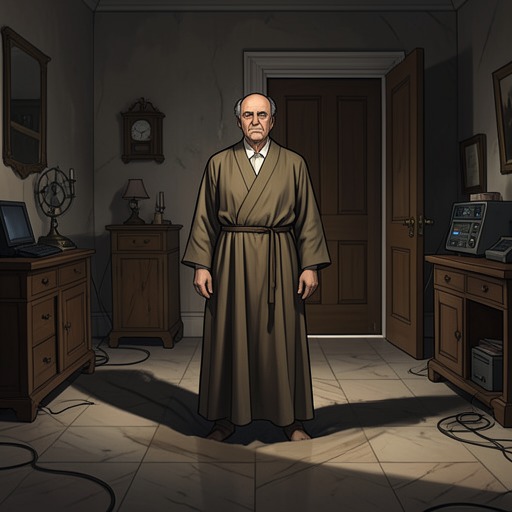
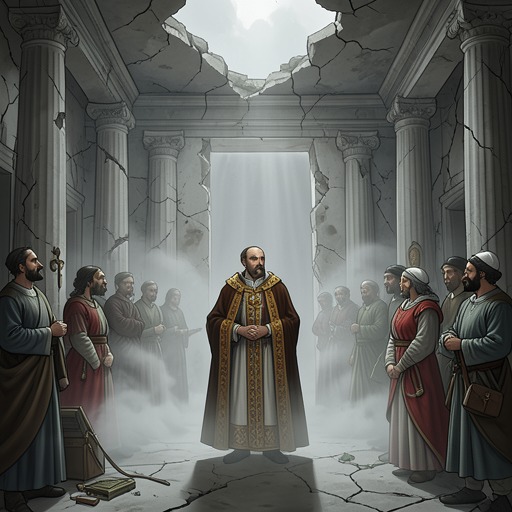
The KillerKing Berenger’s kingdom is depicted as a country coming apart on every scale: its landscape is failing, its territory is shrinking, and its population has almost vanished. The kingdom’s collapse is presented not as a single catastrophe but as the accumulated consequence of neglect, military defeat, and mass departure, until what remains is described as a widening void cut off from its neighbors.
A Landscape in Ruin
Queen Marguerite describes the palace as crumbling, the fields as fallow, and the mountains as sinking. The sea has broken through the dikes and flooded the country; acre after acre has plunged into the earth, leaving the kingdom full of holes. She blames Berenger the First for letting the country deteriorate and argues that the threatened ground might have been stabilized by planting conifers in the sand and cementing vulnerable areas. Her account makes the damaged terrain a measure of failed stewardship. Queen Marie responds with sarcasm, treating the proposed remedy as expert advice for stopping an earthquake, but the physical ruin itself is not in dispute.
War, Retreat, and Depopulation
The kingdom has also suffered disastrous wars. Queen Marguerite recalls that soldiers slept through the night or after lavish lunches in their barracks while neighboring forces pushed back the frontier posts. The national boundaries shrank as the soldiers refused to fight. Queen Marie calls them conscientious objectors; Queen Marguerite observes that at home they received that name, while victorious armies called them cowards and deserters and shot them. The aftermath is visible in razed towns, burnt-out swimming pools, and abandoned bistros. The young leave the country in hordes, turning military defeat into a demographic crisis as well as a territorial one.
Queen Marguerite contrasts the nine thousand million inhabitants present at the start of Berenger the First’s reign with a population reduced to about a thousand elderly people, or fewer. Even while she speaks, she says, people are dying. The figure gives the kingdom’s collapse an intimate, ongoing dimension: its remaining population is not simply small but vanishing in the present.
What Remains
When Berenger the First asks how his country is that morning, Queen Marguerite answers that only what remains can be counted. He treats those remnants as a few tidbits worth watching and calls for his ministers, while the kingdom’s condition makes that routine gesture seem detached from the scale of the disaster. Elsewhere, Queen Marguerite says the country has already lost its frontiers and is separated from its neighbors by an ever-widening gulf. Juliette regards that separation as protection against invasion; Queen Marguerite instead describes the country as poised over a gaping chasm, with nothing but a growing void around it. The contrast captures the kingdom’s final condition: isolation may offer a fragile kind of safety, but it also registers the near-total disappearance of the country and its people.